State of Delaware, County of New Castle
On this 14th day of September personally appeared before me Jacob Steitz, aged 76 years, who being duly sworn doth depose that he served in the 2nd Delaware Regt.
If your ancestor served America before 1900, we read their records — all of them.
A soldier's records are often the only place the federal government wrote down an ordinary person's life: what he did for work, what ailed him, who his neighbors were, who vouched for his marriage. We read the whole file — service record, pension file, or court-martial transcript, from the Revolution to the War with Spain — and tell you what it says, and what it doesn't.
Which records exist for your ancestor depends on his war and his side, and where a cell below says no federal record exists, that's worth knowing too. Prices link to each war's own page.
A record's reliability is not uniform across these wars, and the report never pretends it is. A Revolutionary War pension rests on sworn memory given fifty years after the fact; a Civil War muster roll was written the day it happened. We weigh each by how close it stands to the event, and say so on the page.
Ordering two or more soldiers? Ten percent off the total. And historian-register project work (a regiment's worth of pension files, say) is quoted as a project, not priced by the row. Write first; we'll scope it together.
Written for a family reader, not a research audience. Every finding points somewhere you can go next.
Complete reports, start to finish, including the parts where the record wouldn't answer the question. Some sample soldiers are invented so that no real family's file is published; the rest are clearly marked "real file": public records like a celebrated 1864 court-martial, Confederate pensions the state archives publish freely, and the founder's own research on his camp's namesake. Every document type, tier, flag and citation is exactly what you'd receive.
A widow's file read end to end: the marriage proved, the children named, and two death dates weighed in the open instead of silently averaged.
Read the report → Civil War · Navy pensionJosiah enlisted under a name that wasn't his, as sailors so often did. Both names traced to the page, and the wartime service of his ships verified.
Read the report → U.S. Navy · Court-martial, 1865A real 1865 file: an engineer dismissed at the Brooklyn Navy Yard, the charges named against the 1862 Navy code and the sentence read against what it allowed.
Read the report →All the sample reports, grouped by war: one for every product →
Fair question, and you genuinely can. What you'll get back is a decent summary of the pages you handed it. What you're buying here was never the software: it's the researcher the method was built from. Three of the four reasons below come from a lifetime in these records; the fourth comes from the economics of the tools themselves.
We ran the experiment on a real file: a Revolutionary War pension in the National Archives, already published here as a sample. Same model, no method, the question anyone would type. It reads well. It also writes a confident explanation for a rejection the file never accounts for, from a law it half remembers.
Read the transcript → The receiptsWhat the plain run got right, what it silently got wrong, and what a researcher-built method catches, statute citations included. The file is public and the experiment is repeatable: pull the same pages from the digitized pension series and check both of us.
Read the comparison →What you are paying for, plainly. A researcher-designed reading of the complete file, with every fact tied to the original page that states it. If you're building a lineage-society application, that structure is the point: societies accept the original records as evidence, and this report is the finding aid that walks you to them, page by page, ready to verify.
And plainly about the tool. A person designed this method and the software drafts within it, never outside it. It will not ship a report unless every page is accounted for, and the reviewed edition puts a researcher back over every flagged entry against the original scans. The AI is the draftsman here, not the historian.
A pension file is a stack of forms answering a law most families never see. Every report names that law: the acts each claim was filed and decided under, with a plain synopsis of what each one required, tied to the document in your file that turns on it. When a claim is approved, cut, or refused, you learn the statute that caused it, not a guess. When a rate suddenly jumps, you learn the act that raised it.
Why this is rare. No plain AI run carries it, and few reports of any kind do, because it takes reading the laws themselves, act by act, before a single file is opened. It is the difference between telling you what a form says and telling you the rule the veteran or his widow actually faced, and why the government answered the way it did.
It isn't a transcription. Ancestry and Fold3 will type the words out for you, and increasingly they'll do it free. Knowing which fourteen pages of a hundred actually matter is a different job.
It isn't a research engagement. No consultation, no hourly estimate, no waiting three months for a quote. One fixed price, and a report back in days.
It isn't a story we've written for you. Where the record is silent, the report says so. That's the whole point of paying someone who knows these files.
Prices are on the coverage map above and on each war's own page, where each report is described in full. You send the file you already have, and if you don't have it yet, here is exactly how to get it.
Automated edition. Every report at these prices is a finished automated report. We read it through once before it goes out to catch obvious errors, but we don't check each reading against the original documents, and the report tells you so, every time. Reviewed edition. A person re-reading every flagged entry against the original scans, opening later. Join the waitlist and today's prices are held for you, whatever they become.
Same-named soldiers are the oldest trap in this work, and even careful families sometimes pull the wrong man's file. So the guarantee is simple:
We stand behind this because we're confident in the process: every order is checked against the soldier you named before it ships, and every report states plainly what the file establishes and what it doesn't. What matters to us is that you end up satisfied, holding the most accurate account of your soldier the records can give.
One honest note on the two editions. The Automated report traces every fact to its page in a single complete pass, and tells you on the page wherever a hand should still check the original. The Reviewed edition is that second hand, a researcher going back over every flagged entry against the scans. The guarantee covers whether it is your soldier either way; the editions are how far you want the reading pushed on everything around him.
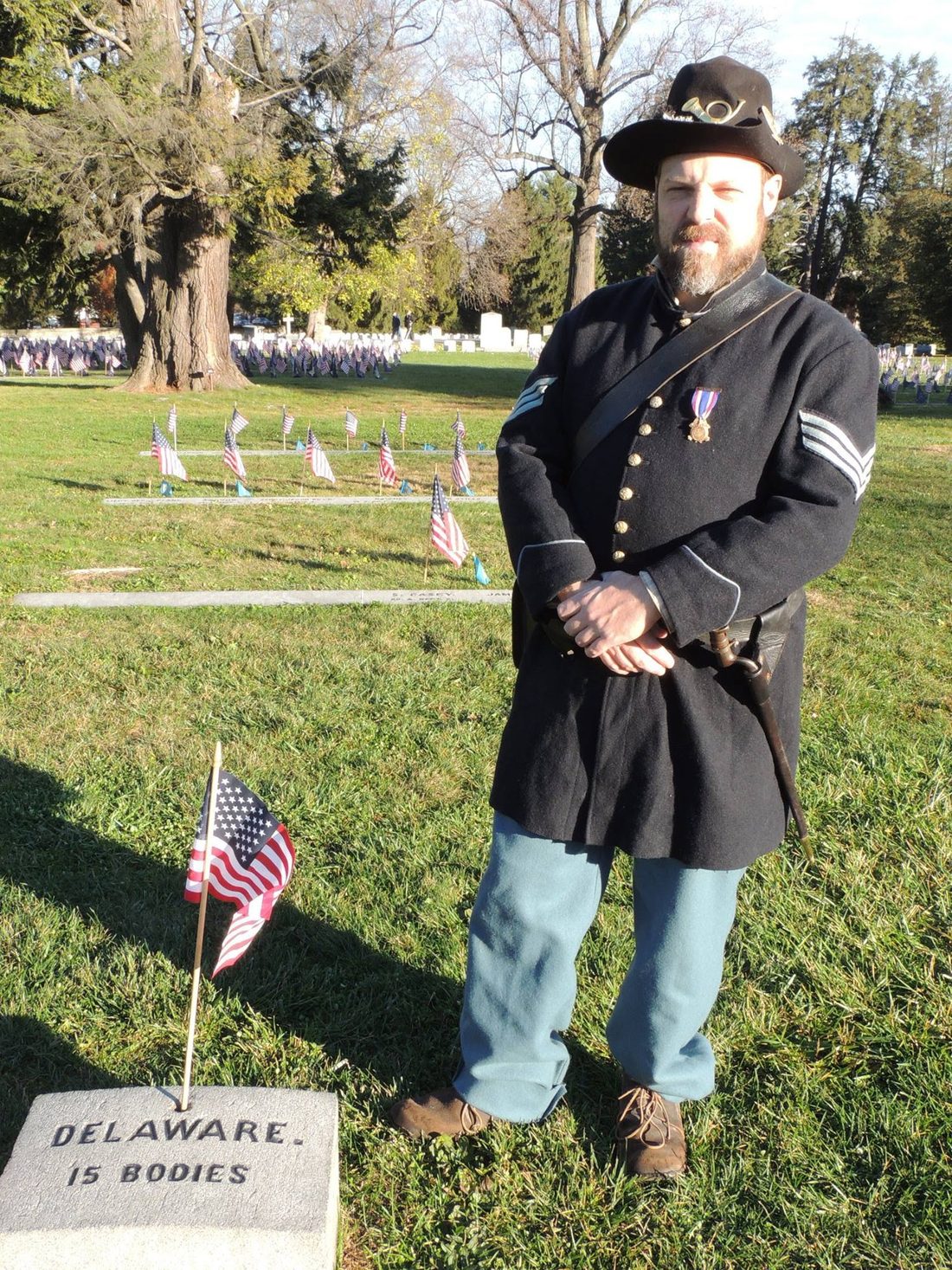
Fifteen Delaware men lie under this stone. It does not name them.
Some of those names survive anyway: in muster rolls, in casualty sheets, in the pension files their widows and mothers filed for years afterward, swearing to marriages and births in front of a justice of the peace because the government would not take their word for it.
That paperwork was written to settle a claim. It's the only reason we can say anything at all about most of these men now.
Sean Protas
Historian · Author · Sons of Union Veterans
I've read more than two hundred pension files researching the 2nd Delaware Infantry. That's where this came from: enough files to know what these records reliably establish, and what they only appear to.
The hard part was never the handwriting. It's knowing that a pension rate rose in 1907 because Congress changed the law and not because a man's health failed, that an R on a Revolutionary War file doesn't always mean the claim was rejected, and that a widow's sworn account of a marriage forty years earlier is strong evidence of one thing and weak evidence of another. Those distinctions are what you're paying for.
In the field with a reenacting unit since 2005, including a few turns as a soldier on film. A history degree from the University of Delaware.
My own family lineage runs to Musician Charles H. Minnemeyer of the 11th Pennsylvania Reserves Infantry, the line my Sons of Union Veterans membership is documented on. I've had to prove a lineage myself, out of these same records.
The deepest archival mileage I have is in Civil War Union files, and that is where this method was built and proven. What carries it into the other five wars is not a claim to equal depth in each. It is the method itself, the same tiered reading of the evidence, and the fact that I went to the statutes of every war and every Confederate state and read the pension acts from the original session laws before a file was ever read against them. The expertise that travels is the discipline. The law is read, not remembered.
I built the process that produces these reports, and everything about the way it flags uncertainty rather than filling it in comes from knowing what these tools do when nobody constrains them. I'm a historian and researcher, not a board-certified genealogist. That is a real credential, and it is not one I hold. What I bring is documentary knowledge: I know these record groups, the acts behind them, and the places where they go quiet.
We're opening in stages, by record type. The more you tell us, the sooner we get to yours.
Start getting the file now. It's the longest part of the journey, and our free guides walk you through your war step by step. The report takes days once the file is in hand.
Read a finished report while you wait. Every product has a complete sample, start to finish, free.
Follow the stories. Our newsletter, A Soldier's Life, tells one soldier's story from his own records, free, every week.
And when orders open, today's prices are held for you.